The Power of In-Situ Machining for Pump Casing Rehabilitation
Introduction to In-Situ Machining
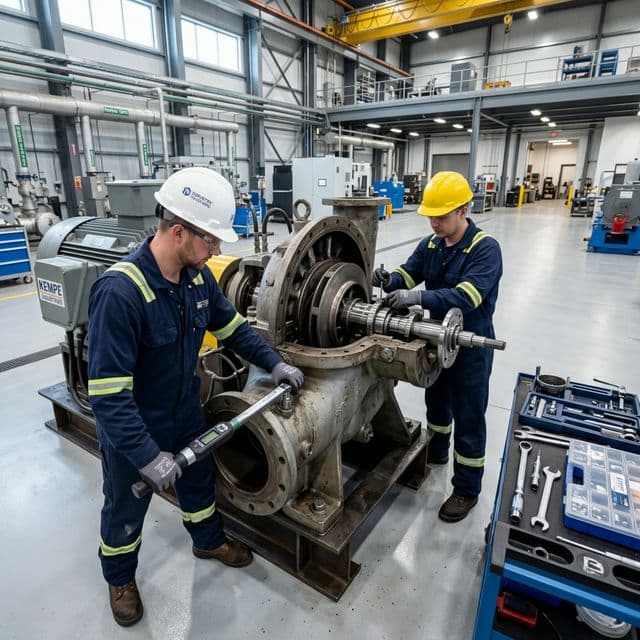
In thermal power stations and heavy chemical plants, large centrifugal pumps—such as Boiler Feed Pumps (BFP) and Boiler Circulation Pumps (BCP)—have massive cast or forged steel casings that are directly welded or heavy-flanged into the main process piping.
Over years of continuous high-pressure, high-temperature service, the mating faces of these casings inevitably degrade. Steam/water wire-drawing, erosion, and chemical corrosion can cause leaks across the main joint flanges.
Historically, repairing these sealing faces required: 1. Cutting the casing weld joints or unbolting massive pipework. 2. Rigging and hoisting the multi-ton casing out of the plant. 3. Transporting it to a heavy machine shop with large boring mills. 4. Re-welding and heat-treating the casing back into the process line.
This cycle could easily take 2 to 3 weeks of critical outage time, costing plants millions of rupees in lost production. In-situ machining solves this problem by bringing the machine tool to the workpiece.
---
Portable Precision: How In-Situ Machining Works
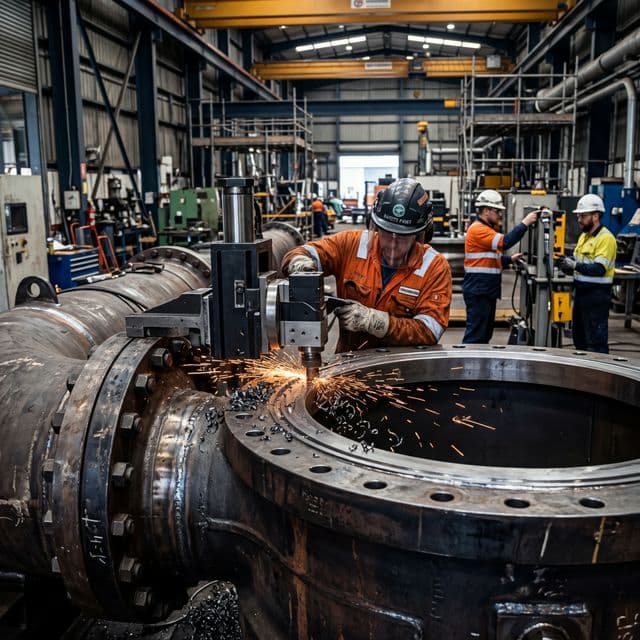
In-situ (or on-site) machining uses high-precision portable boring bar systems, flange facers, and milling machines that are mounted directly onto or inside the pump casing.
- Rigid Alignment: The portable machine is centered using micro-dial indicators relative to the pump's original bore centerline.
- Single-Setup Operation: The machine can perform boring, face cutting, counterboring, and groove cutting in a single setup to ensure absolute concentricity.
- Surface Finish Quality: Modern portable tools are capable of achieving surface finishes down to Ra 1.6 or Ra 0.8 micrometers, matching workshop-grade tolerance levels.
---
Key Applications in Pump Rehabilitation
1. Flange Face Re-Facing Erosion or blowout of gaskets ruins the serrated finish of casing joints. Portable flange facers cut a new gramophone or spiral serrated finish onto the gasket mating face, restoring seal integrity.
2. Bore Machining and Sleeving Wear-ring landing bores inside the pump casing erode over time, increasing the gap between the casing and impeller wear ring. This bypass flow reduces pump efficiency. In-situ boring bars machine the worn bore oversize, allowing a custom sleeve to be shrunk-fit and bored back to original design dimensions.
3. Stud Extraction and Thread Re-cutting Corroded or seized casing studs often snap during disassembly. On-site drilling and tapping units extract the broken stud and re-cut the thread (or install thread inserts) without compromising casing integrity.
---
Economic and Operational Benefits
The principal benefit of on-site machining is time compression. By eliminating the need to cut the casing out of the system: - Outage windows are compressed from weeks to 24–48 hours. - Rigging risks in cramped power plant corridors are eliminated. - Welded piping joints are left untouched, avoiding post-weld heat treatment (PWHT) and radiographic testing.
Conclusion
At DEI VOX India, our dedicated in-situ machining division is equipped with state-of-the-art portable machine tools and highly trained machinists. We mobilize quickly to power plants across India, restoring pump casings and large industrial flanges to original tolerances directly on-site.
Published by Machining Specialists, DEI VOX
Published: April 28, 2026