Submersible Pump Motor Rewinding: Technical Best Practices
The Challenge of Wet-Motor Submersible Rewinding
Industrial submersible pump motor units are designed to operate fully submerged in water, wastewater, or chemicals. Many high-voltage, high-power submersible motors are wet-rotor designs, meaning the interior of the motor is completely filled with clean water or an oil-water emulsion. The water acts as a cooling medium and lubricates the sleeve and thrust bearings.
This configuration presents an extreme challenge for the electric motor winding insulation: - The copper winding wires are in direct, continuous contact with water. - Winding insulation must withstand high electrical potential (up to 11kV) while submerged. - Thermal expansion and contraction cycles stress the insulating barriers. - Any micro-voids, scrapes, or defects in the wire insulation will lead to water ingress, ionization, and immediate ground fault failure.
Rewinding a wet submersible motor requires vastly different materials, tooling, and quality controls compared to air-cooled industrial motors.
---
Essential Technical Best Practices
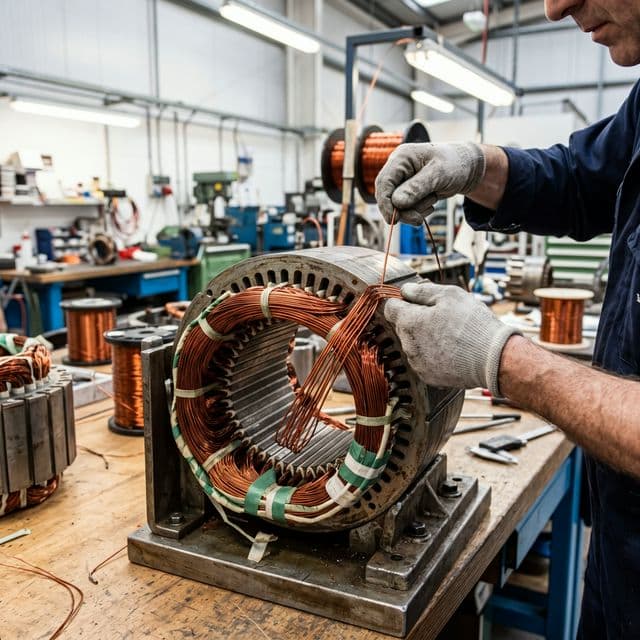
1. Wire Selection: Submersible Magnet Wire Standard enamel-coated magnet wire is entirely unsuitable. Submersible wet motors must be wound using specialized PE (Polyethylene) or PA (Polyamide / Nylon) insulated copper wire. - Double Insulation: A primary layer of high-density polyethylene provides dielectric strength, wrapped in a secondary protective sheath of polyamide/nylon to resist mechanical scraping during coil insertion. - Continuous Leads: Lead joint connections inside the motor should be minimized. DEI VOX ensures winding leads are brought out continuously to the terminal gland to prevent joint degradation underwater.
2. Slot Liner and Phase Insulation Slots must be lined with heavy-duty polyester film (e.g., Mylar or Nomex) capable of resisting water absorption. Slot wedges must be made of non-hygroscopic composite materials that will not swell or degrade when continuously submerged.
3. Joint Vulcanization and Sealing Winding joint connections must be wrapped with self-amalgamating waterproof rubber tape and sealed with heat-shrinkable vulcanizing sleeves. The entire joint is pressure-tested underwater to verify hermetic integrity.
---
Electrical Testing Protocols
To guarantee a reliable rewind, the motor must undergo rigorous electrical diagnostic testing at multiple stages:
| Test Stage | Test Description | Success Criteria |
|---|---|---|
| Dry Insulation | Megger testing of stator winding before assembly | > 1000 MΩ at 1000V |
| Wet Immersion | Submerging the wound stator in water for 24 hours followed by insulation resistance check | > 100 MΩ (Submerged) |
| High Potential | AC or DC Hi-Pot test on the submerged stator | Zero leakage current at rated test voltage |
| Surge Comparison | High-frequency voltage pulses to detect turn-to-turn insulation defects | Symmetric waveforms across all three phases |
---
Conclusion
Submersible motor rewinding is a highly skilled craft that cannot be cut-short. Using the wrong class of wire, low-grade slot materials, or failing to perform wet immersion tests invariably results in premature motor failure within weeks of installation.
DEI VOX India operates a dedicated, ISO-certified clean winding shop equipped with specialized tooling for high-power submersible motor rewinding. Each motor undergoes our strict 24-hour wet-submersion testing protocol before final assembly, giving plant operators complete confidence in the longevity of their repaired assets.
Published by Electrical Engineering, DEI VOX
Published: March 12, 2026